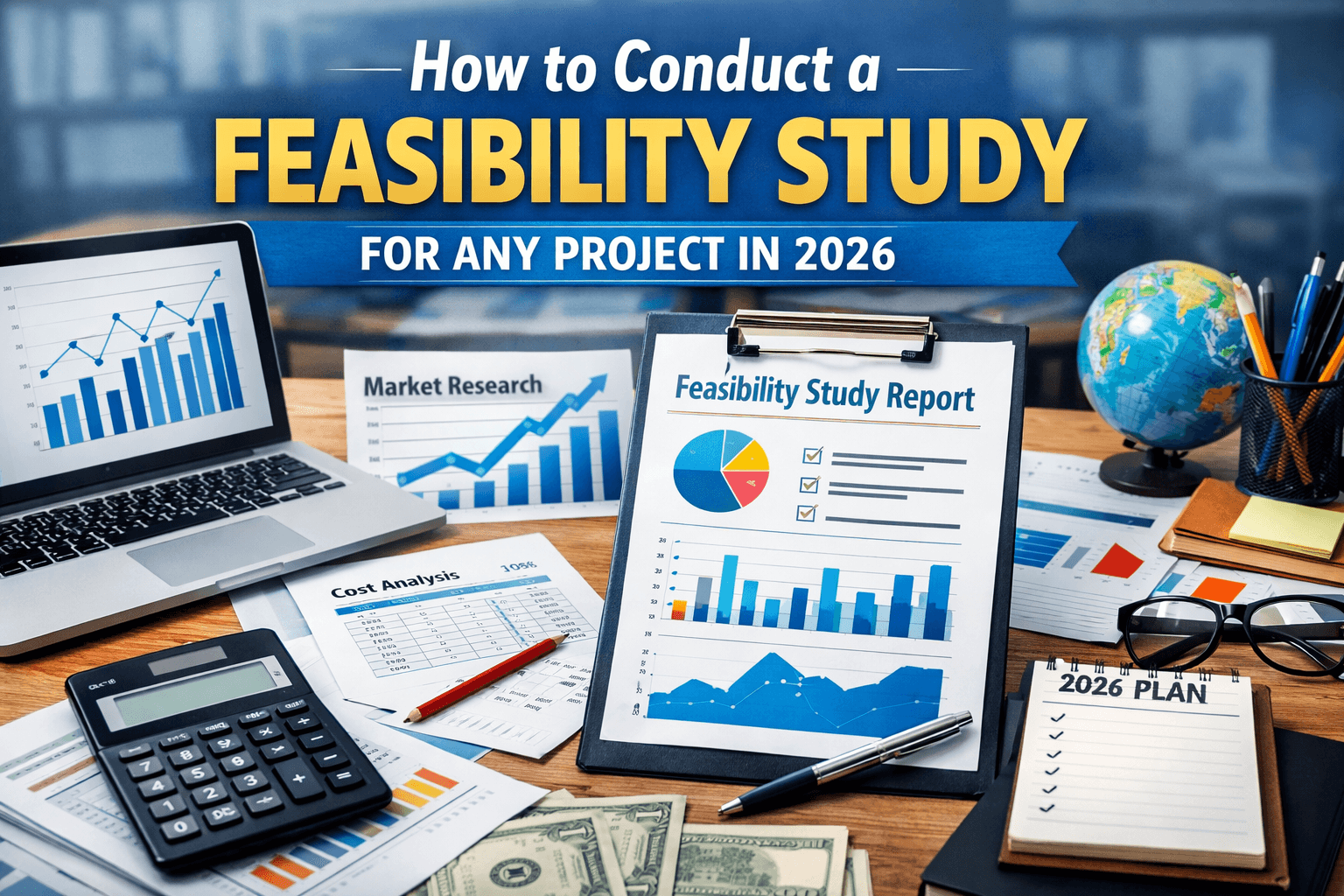
How to Conduct a Feasibility Study for Any Project in 2026 (Complete Practical Guide)
Starting a new business or project in 2026 requires more than just a good idea. The market has become highly competitive, customer expectations are constantly evolving, and financial planning is more important than ever.
This is why learning how to conduct a feasibility study for any project in 2026 is a critical step before investing time, money, or resources.
In this comprehensive guide, you will learn a clear, practical, and realistic approach to preparing a feasibility study. The goal is to help you evaluate whether your project idea is viable, profitable, and worth pursuing.
“A feasibility study is not paperwork — it is the decision-making tool that protects your investment.”
What Is a Feasibility Study?
A feasibility study is a structured analysis conducted before launching a project to determine whether the idea is practical and financially viable.
It evaluates multiple factors including:
- Market demand
- Competition
- Operational requirements
- Financial projections
- Potential risks
Instead of relying on assumptions, a feasibility study uses data and realistic estimates to help entrepreneurs make informed decisions.
Even small projects benefit from a simplified feasibility study. Skipping this step often leads to unexpected financial losses.
Why Feasibility Studies Are More Important in 2026
The business landscape in 2026 is shaped by rapid technological change, global competition, and digital transformation. These factors make careful planning essential.
A feasibility study helps you:
- Understand the real demand in the market
- Estimate startup and operational costs
- Predict potential revenue
- Identify risks before they become problems
- Improve your business strategy
Without this analysis, many projects fail within the first year simply because expectations were unrealistic.
Types of Feasibility Studies
To fully understand how to conduct a feasibility study for any project in 2026, it’s important to know the different components involved in the analysis.
| Study Type | Purpose | Key Focus |
|---|---|---|
| Market Feasibility | Analyze customer demand | Target audience, competitors, demand size |
| Technical Feasibility | Evaluate operational requirements | Technology, equipment, production process |
| Financial Feasibility | Assess profitability | Costs, revenue projections, ROI |
| Legal Feasibility | Ensure regulatory compliance | Licenses, regulations, legal restrictions |
A complete feasibility study combines insights from all of these areas.
How to Conduct a Feasibility Study for Any Project in 2026 (Step by Step)
Now let’s move to the practical steps you can follow to analyze any project idea.
1. Clearly Define the Project Idea
The first step is defining your project concept clearly.
Ask yourself:
- What problem does this project solve?
- Who is the target customer?
- What makes this idea different from competitors?
- Is the idea scalable?
A clear definition helps guide the rest of the feasibility analysis.
“A strong business idea solves a real problem for a specific group of people.”
2. Conduct Market Research
Market analysis is one of the most important stages of any feasibility study.
The goal is to determine whether there is sufficient demand for your product or service.
Key Market Research Elements
- Identify your target audience
- Analyze competitor offerings
- Understand pricing structures
- Estimate market size
| Factor | What to Analyze |
|---|---|
| Customers | Age, income level, needs, behavior |
| Competitors | Pricing, quality, market positioning |
| Demand | Estimated market demand for the product |
| Market Gap | Opportunities competitors are missing |
Use data sources like Google Trends, industry reports, and customer surveys to validate market demand.
3. Identify Startup Costs
Once the market opportunity is clear, the next step is calculating the initial investment required.
Typical Startup Costs Include
- Office or store rent
- Equipment and tools
- Licensing and registration fees
- Marketing expenses
- Employee salaries
- Operational expenses
| Cost Category | Example Estimated Range |
|---|---|
| Business location rent | $300 – $1,200 per month |
| Equipment | $1,000 – $15,000 depending on the project |
| Marketing budget | $200 – $2,500 monthly |
| Licensing | $100 – $1,000 depending on location |
Actual costs vary widely depending on the country, industry, and project scale.
4. Estimate Revenue Potential
Revenue projections are based on expected sales volume and pricing.
A simple revenue estimation formula is:
Expected Customers × Average Price
Example Calculation
| Metric | Value |
|---|---|
| Daily customers | 30 |
| Average purchase | $10 |
| Daily revenue | $300 |
| Monthly revenue | $9,000 |
These estimates should remain conservative to avoid unrealistic expectations.
5. Calculate the Break-Even Point
The break-even point is when your total revenue equals your total expenses.
After this point, the project begins generating profit.
“The faster a business reaches its break-even point, the more financially stable it becomes.”
Understanding this milestone helps determine how long it may take for the investment to recover.
6. Identify Potential Risks
Every project carries some degree of risk. Identifying risks early allows you to prepare mitigation strategies.
Common Business Risks
- Lower than expected demand
- Increased operational costs
- New competitors entering the market
- Regulatory changes
| Risk | Possible Solution |
|---|---|
| Low sales | Improve marketing and product positioning |
| High costs | Negotiate better supplier contracts |
| Strong competition | Differentiate through value or quality |
Tools That Help Create a Feasibility Study
In 2026, several digital tools make feasibility analysis easier and more accurate.
Google Trends
– Analyze search demand and market interest
SimilarWeb
– Study competitor traffic and market data- Google Sheets or Microsoft Excel for financial calculations
- Survey tools such as Google Forms for customer feedback
Common Mistakes in Feasibility Studies
Many new entrepreneurs make mistakes that lead to inaccurate results.
- Overestimating potential revenue
- Ignoring competitors
- Underestimating operational costs
- Using unrealistic assumptions
A realistic feasibility study is more valuable than an overly optimistic one.
Can You Create a Feasibility Study Without Professional Experience?
Yes. Many entrepreneurs start by preparing a basic feasibility analysis on their own.
Later, they may refine the study with financial advisors or business consultants.
“You don’t need to be a financial expert to understand your business idea — you just need accurate numbers.”
Final Thoughts
Learning how to conduct a feasibility study for any project in 2026 is one of the most valuable skills for entrepreneurs.
By analyzing the market, estimating costs, projecting revenue, and evaluating risks, you can determine whether a project idea is worth pursuing.
A strong feasibility study transforms an idea into a structured business opportunity. It reduces uncertainty and increases the chances of long-term success.
Before launching your next project, invest time in a detailed feasibility study — it could save you significant resources and guide you toward better decisions.